AGM – Dedicated to the Restoration of Slaithwaite Village Mill Pond
26 September 2023 by webadmin
AGM – Dedicated to the Restoration of Slaithwaite Village Mill Pond
This year’s Annual General Meeting, dedicated to the restoration of Slaithwaite Village Mill Pond and as chaired by the Founder of Friends of Slaithwaite Millpond, My Keith Anderson, covered pertinent issues including progress to date, future plans, and how you can get involved in revitalizing the cherished community landmark, “a chance to make a positive impact on Slawit village heritage!”
The AGM was filmed for posterity and for those who were unable to attend, with filming services kindly provided by prolific YouTube vlogger, Robert John Kerr who is passionate about Yorkshire and creating short films, vlogging, Hiking, Walking, Camera Tech, he has his own YouTube channel [Here]
Video footage of our latest AGM courtesy of Robert John Kerr.
Slaithwaite Millpond Restoration
6 September 2023 by webadmin
Slaithwaite Millpond Restoration & more…
Prolific YouTube vlogger, Robert John Kerr, has documented his latest visit to Slaithwaite which includes a local walkabout the village, taking in some of the sights and a revisit to the Millpond. Robert also treats us to his own personal vision of how the millpond could be once the ambitious restoration project is complete.
Robert is passionate about Yorkshire and creating short films, vlogging, Hiking, Walking, Camera Tech, he has his own YouTube channel [Here]
Robert John Kerr vlogs from Slaithwaite village & our beloved millpond.
Slaithwaite’s Industrial Past
14 July 2023 by webadmin
Slaithwaite’s Industrial Past
Slaithwaite’s local economy was a very different landscape during the Industrial Revolution, Michael Blake gives us a taste of what it was like and the significance of millponds….
Globe Mill, Slaithwaite (Jul-2023)
Millponds in Context
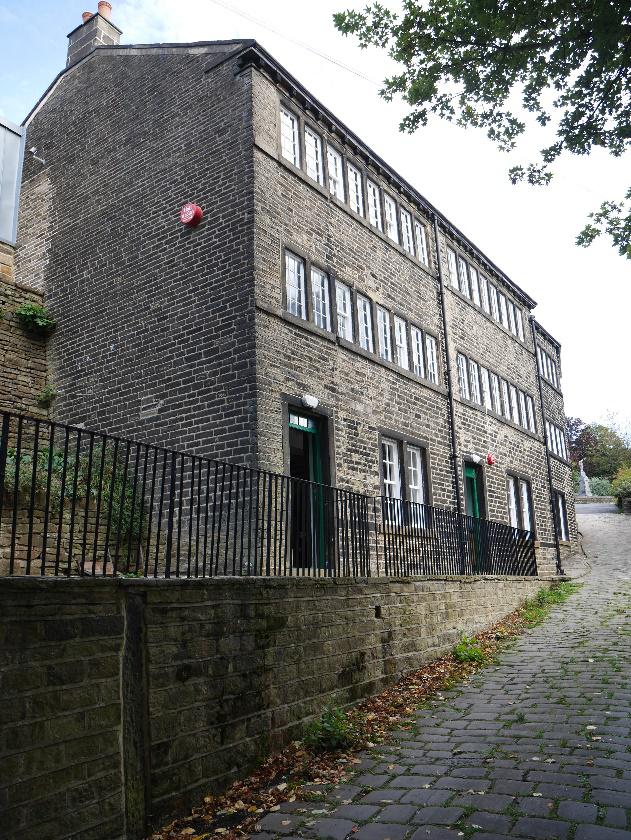
Cloth has been produced in the Colne Valley for at least three hundred years. In the eighteenth, and in the first half of the 19th century, the cloth would have been produced in the home, or in small workshops on handlooms. The picture below of a cottage built in Golcar in 1845 shows the typical rows of mullion windows built to let in light to the first and second floor work rooms. The family would have lived on the ground floor.
The second half of the 19th century saw the mechanisation of cloth production and production move from a domestic setting into large mills. The weavers cottages and mills existed side by side for half a century but lower costs of production at the mills saw the end of the domestic trade.
A century ago Slaithwaite would have been a very different place. The valley floor would have been full of large mill buildings, the valley would have been a forest of smoking chimneys, and both the air and the water in the river heavily polluted. There was a Gas Works and sewage treatment plant on Bridge Street, builders yards, blacksmiths, coal yards, stables for the horses that did all the carrying before motor vehicles, a variety of factories and workshops dotted around the village centre and of course coal powered steam trains running up and down the valley all added to the industrial mix. The photograph below give a flavour of what it would have looked like. Heavily polluted air meant few trees.
The only mills that survive today are Spa Mill on New Street, Globe Mills on Bridge Street, and Upper Mills on the canal side. Spa Mill was one of four operated by Slaithwaite Spinning Co, the other three occupying the present site of Shaw Pallets, Slaithwaite Health Centre and the car park opposite. There were similar sized mills, Crimble Mills and Brook Mill at Crimble, Colne Mill on the site of Aldi, Commercial Mills below Upper Mill and Bridge Street Mill in Bridge Stret on a site also occupied by Shaw Pallets.
The mills depended upon water for power, but could not rely upon a small river like the Colne to produce a regular and plentiful supply. The purpose of a mill pond was to store water and regulate the flow of water to the mill. Water in the river was held back by the construction of a weir in the river bed. Sluices controlled the flow of water through a channel (goit) to the mill pond. The goit might run a considerable distance, as was the case with that supplying Upper Mills shown on the photograph below. The overgrown channel is still visible between Locks 24E and 25E to anyone walking along the canal towards Marsden. The weir that fed it is in the river bed below the iron bridge that takes a footpath up to Bluebell Farm on Manchester Road.
The same picture shows the weir behind the former Commercial Mills that fed the former mill pond at Colne Mill, where Aldi now is, and the mill race that the group are attempting to clear and renovate. The weir can be viewed from the rear of the unit occupied by Waves in Upper Mills.
The mill race that is the subject of the groups interest passes under Britannia Road and would have fed Britannia Mills, the home of Brook Dyeing. Britannia Mill hides a further picturesque channel fed by Bridley Brook and there is a large weir behind the second Globe Mill building that awaits renovation, that is also hidden from view.
Written by: Michael Blake Jul-2023
Abandoned Forgotten MillPond, Slaithwaite – A video guide
28 February 2023 by webadmin
Abandoned Forgotten MillPond, Slaithwaite…
Prolific YouTube vlogger, Robert John Kerr, has documented his recent visit to Slaithwaite Millpond and treats us to a virtual tour of the millpond and surrounding areas.
Robert is passionate about Yorkshire and creating short films, vlogging, Hiking, Walking, Camera Tech, he has his own YouTube channel [Here]
An insight into Slaithwaite Millpond by Robert John Kerr, prolific YouTube vlogger.
Huddersfield Hub Feature
31 August 2022 by webadmin
PRESS RELEASE:
Ambitious Scheme To Renovate Slaithwaite Millpond…
The plight of Slaithwaite Millpond and the work that Friends of Slaithwaite Millpond (FoSM) are doing to try to restore a relic of Slaithwaite’s industrial past has drawn intrigue from two of Huddersfield’s prominent sources of local news online, Huddersfield Hub & Yorkshire Live.
You can check out the full feature on the Huddersfield Hub website [Here]
Yorkshire Live have also reported the FoSM story [Here]
Huddersfield Hub have featured the Friends of Slaithwaite Millpond, highlighting some of the challenges & plans ahead to restore the local asset.
Huddersfield Examiner have also featured Slaithwaite Millpond in their printed paper, here’s the snippet;
The Huddersfield Examiner newspaper have featured Slaithwaite Millpond & FoSM’s mission.
Note. FoSM are not responsible for the content published on third party sites or in printed articles
Our first blog
30 July 2022 by webadmin
Our First Blog – The Millpond…
Slaithwaite millpond in the heart of the village is in dire need of remedial works. Where the goit meets the weir, a discarded mattress is a sad testament to the millpond’s neglect and yet this is by far the least of the issues that we wish to address. The village of Slaithwaite was built upon the energy that this water course once supplied, unsurprisingly it has fallen into disrepair. Historically the millpond maintained a meaningful relationship with the River Colne and moreover the Colne Valley, in addition to providing a source of power, the millpond had an integral role in flood prevention. As a hydropower the millpond has long been obsolete and obsolescence will invariably lead to neglect.
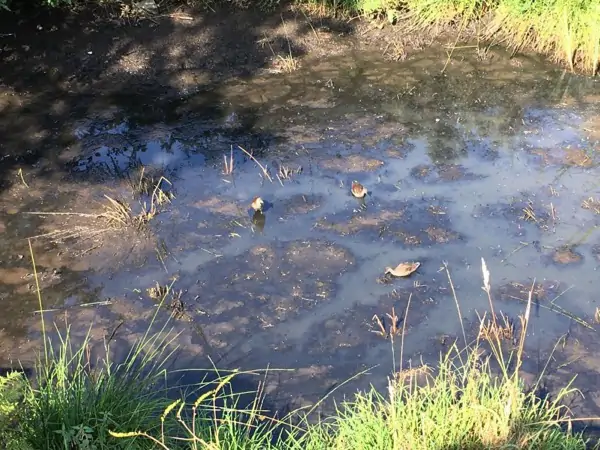
The upper millpond dried out again this year…unfortunately, the moorhens abandoned their brood.
The various landowners whose titles span the land from the weir in the West, along the goit, the millponds and the reconnection with the River Colne in the East are not individually capable of coordinated remedial action, hence, we believe that Friends of Slaithwaite Millpond have a role to play.
We are committed to redefining and maintaining the existence and functionality of this watercourse in a modern context. Whilst we place a strong emphasis on supporting and preserving the flora and fauna that depend on the millpond for survival, we also wish to preserve the heritage of this important manmade structure for future generations. The millpond has until recently, afforded the Slaithwaite and District Angling Club with an ideal environment for young fishing enthusiasts to develop their hobby and we seek to re-establish this. We also believe that the millpond could contribute to Kirklees flood maintenance programme and we will explore how integration may be achieved.
Our first order of business is to secure the cooperation and support of the numerous landowners and those with a vested interest in preserving both the local heritage and natural resource that the millpond offers. We also seek to raise awareness in the local community and beyond by developing a social media presence and generally making, in so far as is possible, remedial works an inclusive experience for anyone wishing to contribute. We have instigated a robust participant insurance procedure that requires volunteers to register their interest via the Calder and Colne Rivers Trust’s website. Volunteers will benefit from a comprehensive health and safety education based on an in-depth risk assessment. A Link from our fledgling website to the registration process is already in place.
With extensive remedial works of this magnitude, it is hard to know where begin, as there are no blueprints that describe the architect’s original concept of the millpond’s relationship with the river Colne, let alone any indication how of the watercourse could fit into Kirklees’ current flood maintenance programme. We can only examine and consider the current state of the watercourse. Clearly, this requires expert advice and associated costs; one of our primary goals is raising sufficient funds to commission this research.
In advance of expert opinion; Friends of Slaithwaite Millpond have conducted, in association with Calder and Colne Rivers Trust and Slaithwaite and District Angling Club an initial appraisal and developed a draft remedial programme. However, the relevance of our thoughts will in all likelihood require ratification from an ecological appraisal, a macro-invertebrate survey, a fish survey, an in-stream impoundments and structures survey, a silt survey and a chemical water quality survey.
That’s the skip delivered for our de-vegetation works around the millpond.
To date, adhering to landowners’ instructions that restricted participants to Club members, the lower millpond’s access path has been cleared of sufficient flora to afford access for the limited members of the Angling Club that are attempting to fish the lower millpond. An exercise that demonstrated the commitment of the Club to funding and participating in the initial remedial works, whilst affording an opportunity to announce the existence of Friends of Slaithwaite Millpond to visitors of the adjacent Aldi Supermarket via banners kindly supplied by Calder and Colne Rivers Trust.
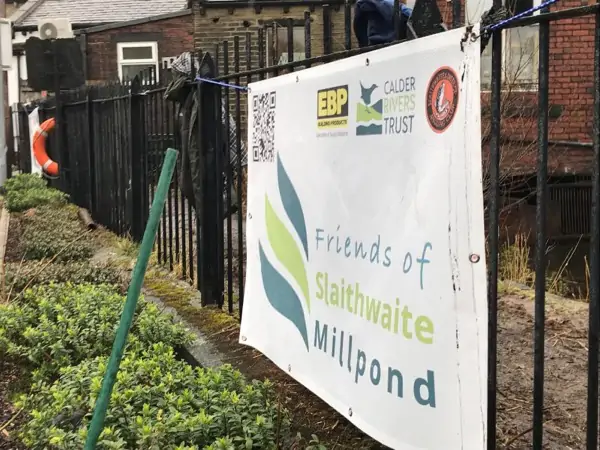
A shot of our banner during the de-vegetation works, if you see it around Slaithwaite we’ll be close-by.
Maintaining the same vein i.e., limited funds we believe our efforts are best directed to clearing the lower millpond of rubbish and detritus that has accumulated. Unlike the previous foliage clearance, these works are labour intensive but will not be subject to disposal costs. In this way we can deliver a relatively immediate positive effect on the experience for the Slaithwaite and District Angling Club members. Obviously, this will not address the most pressing problem, the lack of water to support the fish stock but it will hopefully provide another opportunity to raise awareness whilst improving the experience of Club members.
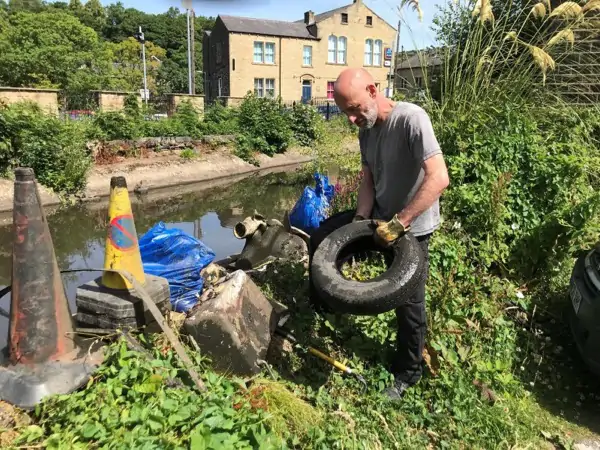
How did that lot get in the millpond…..??? A good days work from Keith & the team, looking a bit tired!
Moving forward; we are reliant on further concessions for works from landowners and perhaps more importantly money. Should we receive the support and cooperation of the various landowners and following the inauguration of the Friends of Slaithwaite Millpond we will be in a position to seek project funding. All being well, it might just be time to remove that mattress and other detritus that litters the goit. In the meantime, further works and research costs will require funding.
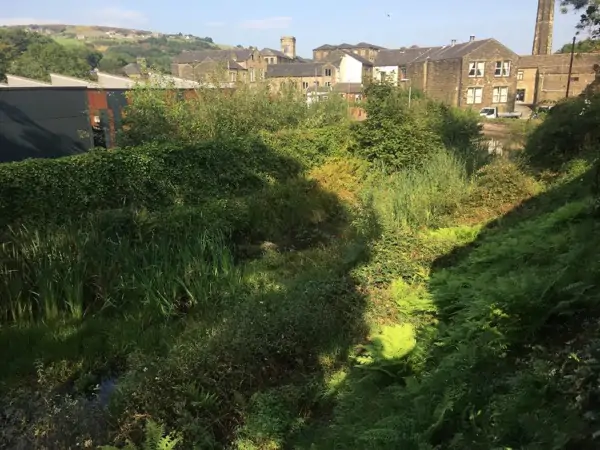
The journey from pond to marsh to dry bed isn’t inevitable if action is taken soon.
We now enter a world of uncertainty but we optimistically suggest that the next stage is the clearance of foliage from the upper millpond’s access path which will in turn make manually digging out the upper section of the millpond, presently a dry bed, possible; removing the silt whilst giving consideration to the current marshland habitat and possibly retaining some elements that recently supported moorhens prior to drying up completely.
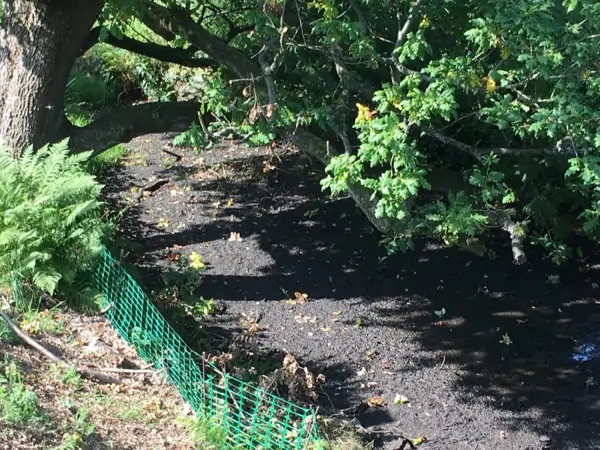
Some parts of the upper millpond are completely silted up, it’s going to take some shifting!
It is important to note that pond silt disposal can be a costly business and costs dramatically vary dependant on contamination levels; hence the pressing requirement for expert opinion. Having potentially cleared excess silt from the upper millpond we will have created a viable environment for fish stock whilst minimising the works impact on recent additions to the environment, namely marshland flora and fauna. That said a key ingredient i.e., water will need to be reintroduced. Prior to the introduction of water and associated works, repairs and an upgrade to the sluice gate that divides the two millponds is required.
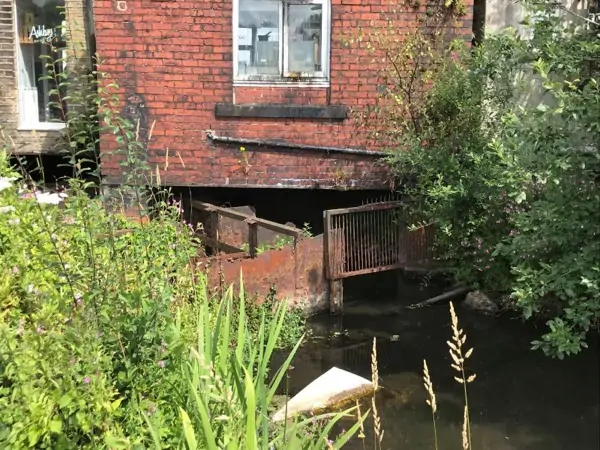
The sluice gate & trash screen have seen better days. We’ve removed a lot of rubbish from this area.
Significant advances in sluice gate technology have been made since the bygone years when the millponds operated as a hydropower. At this stage, prior to a meaningful engagement with Kirklees’ Flood Risk and Drainage Management, we cannot describe the requirements necessary to integrate the watercourse into a flood management programme. Consideration must be given to mitigating and hopefully eliminating potential maintenance costs as we believe landowners will find them unpalatable.
Reconnecting to the weir looks like an impossible task but where there’s a will there’s a way.
Connection with the River Colne requires clearance of silt and flora that currently prevents the feed from the weir at the far Western end of the watercourse travelling along the goit. It will also be necessary to devise a method of reconnection to the weir. It was noted that wooden blanks had previously served this purpose but a more permanent solution should be found. To preserve the heritage, considerable attention should be given the sluice gates along the goit as these structures are potentially prime examples and it is difficult to know just how many still exist today. The iron works have long since rusted away and yet the brickwork remains in various states of disrepair. Perhaps sensitive restoration is an option, clearly guidance from conservationists is required in addition to considering their potential role in a flood management programme.
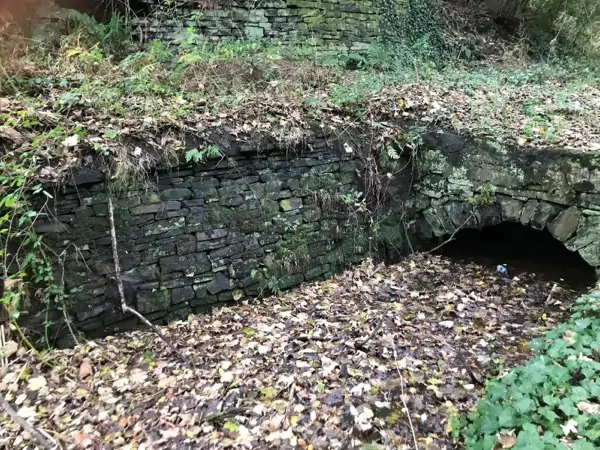
It may not look much but preserving the industrial heritage of the village is high on the list of priorities.
Looking ahead it will be a significant project milestone when the upper millpond is connected to the weir and any surviving fish stock can be relocated from the lower millpond. With the fish extracted the lower millpond can be drained and the silt removed in addition to any remaining detritus. If required repairs can made to the pond bed lining and retaining walls. The iron work filter bed and sluice gate at the far Eastern end of the lower section of the millpond can be inspected, possibly repaired but more realistically replaced. Critically funds must be secured in preparation for the worst-case scenario.
The penultimate phase in the remedial works programme, the opening of the dividing sluice gate filling and restocking the lower pond will represent a massive achievement for anyone involved in the project. The introduction of floating foliage bed islands to encourage birds to nest, planters to replace pondside flora in a more manageable fashion and the creation of numerous safe havens for fish breeding will complete the project.
There’s huge potential to create a wildlife haven by regenerating a relic of Slaithwaite’s industrial past.
Project timing, whilst ultimately controlled by funding programme schedules, should not deviate from the basic principle of minimising disturbance to the remaining fauna. We are fully aware that advancing the project too quickly and without due consideration could result in a catastrophic event. For example; guidance from the RSPB highlighted the need to consider the possibility of wiping out the invertebrate population that forms the life blood of the environment. It’s a steep learning curve; we have and will continue to seek expert advice and opinion at every step of the way.
Project cost estimates of circa £80,000 to £120,000 are somewhat daunting but we have identified numerous potential funding sources and we remain quietly confident that we can secure sufficient funds.
You can also check out our Facebook page for further posts [Here]