Slaithwaite’s Industrial Past
Slaithwaite’s local economy was a very different landscape during the Industrial Revolution, Michael Blake gives us a taste of what it was like and the significance of millponds….

Millponds in Context
Cloth has been produced in the Colne Valley for at least three hundred years. In the eighteenth, and in the first half of the 19th century, the cloth would have been produced in the home, or in small workshops on handlooms. The picture below of a cottage built in Golcar in 1845 shows the typical rows of mullion windows built to let in light to the first and second floor work rooms. The family would have lived on the ground floor.
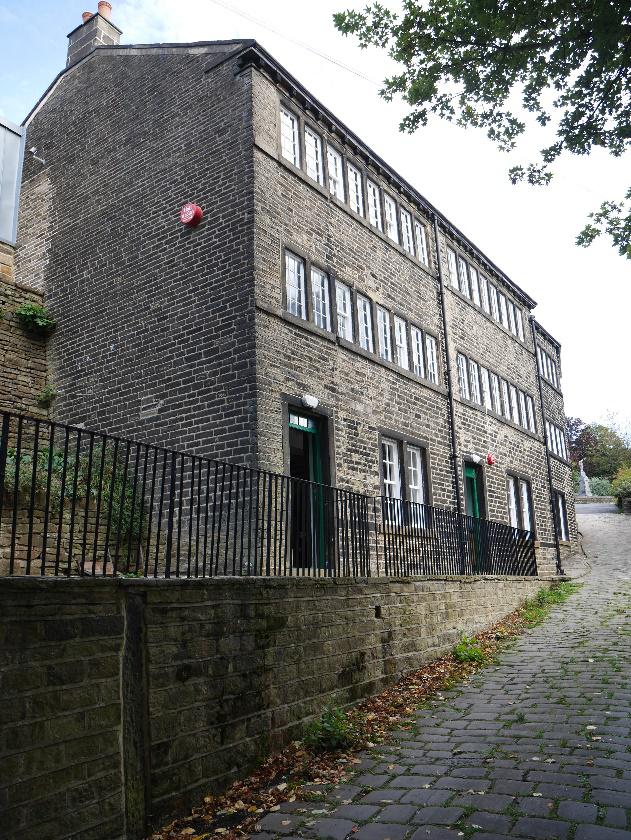
The second half of the 19th century saw the mechanisation of cloth production and production move from a domestic setting into large mills. The weavers cottages and mills existed side by side for half a century but lower costs of production at the mills saw the end of the domestic trade.
A century ago Slaithwaite would have been a very different place. The valley floor would have been full of large mill buildings, the valley would have been a forest of smoking chimneys, and both the air and the water in the river heavily polluted. There was a Gas Works and sewage treatment plant on Bridge Street, builders yards, blacksmiths, coal yards, stables for the horses that did all the carrying before motor vehicles, a variety of factories and workshops dotted around the village centre and of course coal powered steam trains running up and down the valley all added to the industrial mix. The photograph below give a flavour of what it would have looked like. Heavily polluted air meant few trees.
The only mills that survive today are Spa Mill on New Street, Globe Mills on Bridge Street, and Upper Mills on the canal side. Spa Mill was one of four operated by Slaithwaite Spinning Co, the other three occupying the present site of Shaw Pallets, Slaithwaite Health Centre and the car park opposite. There were similar sized mills, Crimble Mills and Brook Mill at Crimble, Colne Mill on the site of Aldi, Commercial Mills below Upper Mill and Bridge Street Mill in Bridge Stret on a site also occupied by Shaw Pallets.

The mills depended upon water for power, but could not rely upon a small river like the Colne to produce a regular and plentiful supply. The purpose of a mill pond was to store water and regulate the flow of water to the mill. Water in the river was held back by the construction of a weir in the river bed. Sluices controlled the flow of water through a channel (goit) to the mill pond. The goit might run a considerable distance, as was the case with that supplying Upper Mills shown on the photograph below. The overgrown channel is still visible between Locks 24E and 25E to anyone walking along the canal towards Marsden. The weir that fed it is in the river bed below the iron bridge that takes a footpath up to Bluebell Farm on Manchester Road.
The same picture shows the weir behind the former Commercial Mills that fed the former mill pond at Colne Mill, where Aldi now is, and the mill race that the group are attempting to clear and renovate. The weir can be viewed from the rear of the unit occupied by Waves in Upper Mills.

The mill race that is the subject of the groups interest passes under Britannia Road and would have fed Britannia Mills, the home of Brook Dyeing. Britannia Mill hides a further picturesque channel fed by Bridley Brook and there is a large weir behind the second Globe Mill building that awaits renovation, that is also hidden from view.
Written by: Michael Blake Jul-2023